How to Iterate on Song Lyrics Until They're Actually Finished
TL;DR: The difference between a first draft and a finished song is almost always a series of deliberate iterations, not a single breakthrough. A practical revision framework has four passes: structural (does the arc work?), rhythmic (can you sing every line?), emotional (does it feel true?), and a final polish pass. Here’s how to run each one.
Almost no great song arrived fully formed. Even artists who describe songs as coming to them “all at once” will often mention that a line was different, a verse was cut, the chorus needed a different ending. The public hears the finished version; the artist lived through the process of getting there.
Understanding that songwriting is revision liberates you from waiting for perfection to arrive. Your job in a first draft is to get the shape of the idea down. Your job in revision is to make that shape true.
Why First Drafts Are Never Finished
A first draft does one essential thing: it makes your idea visible. Before you have a draft, you have a feeling or a vague concept. After you have a draft, you have something specific to react to.
That reaction is where the real work happens. You read a line and think “that’s not quite right” — and that thought is more valuable than any instruction anyone could give you, because it means you know what “right” looks like, even if you can’t articulate it yet.
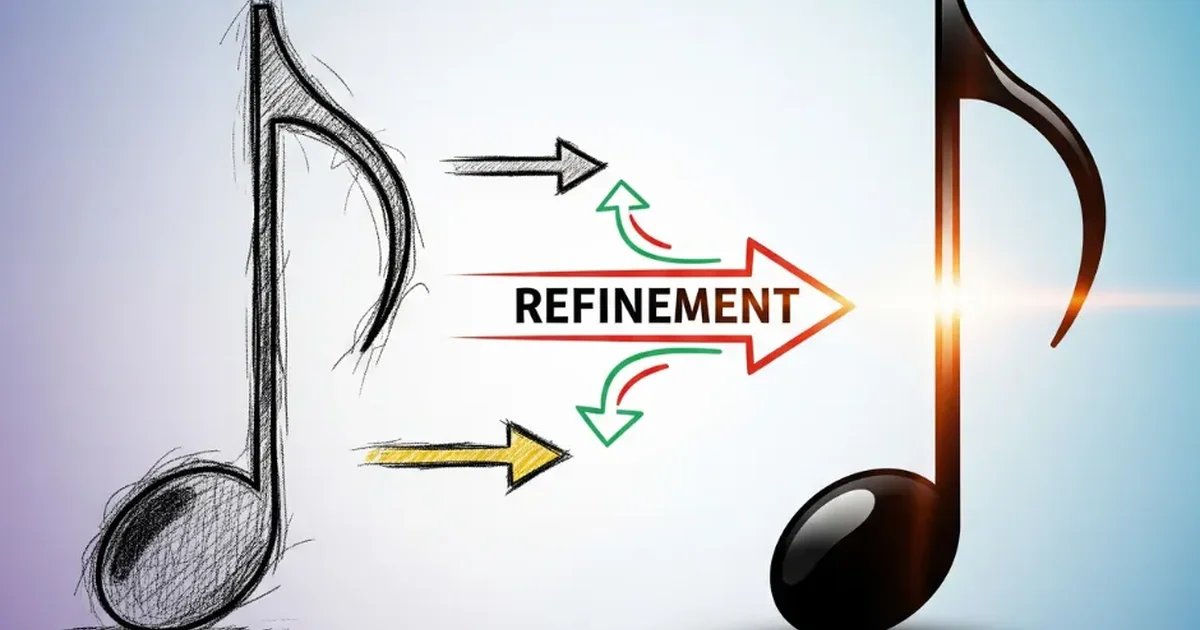
First drafts in Lyric Genie are strong starting points, not finished songs. The platform’s first generation gives you a structurally coherent starting point with real lyrics to react to. The iterations that follow are where the song becomes yours.
Lyric Genie is a chat-based tool that transforms your songwriting ideas into structured, professional lyrics ready for AI music generators like Suno. All your drafts are saved on your My Lyrics page, and the Refine feature lets you continue the conversation from any saved song.
Pass 1: The Structural Pass
Look at the big picture before touching individual lines.
Questions for the structural pass:
- Does each verse reveal something new, or do they repeat the same idea with different words?
- Does the chorus deliver the emotional payoff that the verses set up?
- Is the emotional arc coherent — does the song go somewhere?
- Is anything missing that would make the song feel complete?
If you find structural problems — a redundant second verse, a chorus that doesn’t connect to the verses, a missing bridge that the song seems to need — fix these first. Structural problems upstream create cascading issues in all the lines downstream.
How to do the structural pass in Lyric Genie: Share your full lyrics with a structural question: “The two verses feel like they’re saying the same thing. Verse 1 covers X. What would make Verse 2 different? Can you suggest what the second verse should do differently, then rewrite it?”
Pass 2: The Rhythmic Pass
Read every line aloud. Try to sing every line.
The rhythmic pass reveals what the structural pass misses: lines that look fine on paper but are impossible to sing. Too many syllables, stress falling on the wrong word, a rhythm that breaks the flow unexpectedly.
Signs a line needs rhythmic revision:
- You have to rush or skip syllables to fit the melody
- You’re emphasizing an unimportant word (“and THE dog”)
- The line’s length is significantly different from the other lines in the same section
- You catch yourself thinking “I’ll figure out how to sing this later”
How to do the rhythmic pass in Lyric Genie: “I just sang through the chorus. Line 3 is too long — I need to rush through it and it breaks the melody. Can you shorten it to roughly the same length as lines 1 and 2?”
For a deeper guide to rhythm problems specifically, see the post on fixing lyrics that don’t flow.
Pass 3: The Emotional Truth Pass
This is the hardest pass and the most important one.
For every line, ask: does this feel true? Is it specific enough to be about a real experience, or is it generic enough to be in any song? Are you saying what you actually mean, or the acceptable version of it?
The specificity test: Find your most abstract or general lines. Ask what the most specific true version of that line would be. Concrete, visual, could only appear in this song. Replace the abstract with the specific.
The vulnerability test: What are you not saying in these lyrics? What would be uncomfortable to admit but is more true? The answer to this question is often the most powerful line waiting to be written.
The “would I say this?” test: Read each line as if someone asked you to explain what you mean. Is this what you’d actually say? If you’d say it differently in conversation, the conversational version is often better.
How to do the emotional pass in Lyric Genie: “Line 2 in verse 2 is too abstract — it could be in any breakup song. The specific feeling I’m trying to capture is [describe exactly]. Can you rewrite that line to be more specific and emotionally direct?”
Pass 4: The Final Polish Pass
By this point, the structure works, the rhythm works, and the emotional content is true. The final pass is for fine-tuning:
- Word choice: Is every word the most precise, appropriate word? Are there weak verbs that could be stronger?
- Repetition: Are you inadvertently using the same word or rhyme multiple times?
- Consistency: Does the song’s vocabulary and tone stay consistent? Does anything feel out of register with the rest of the song?
- The ending: Does the song end at the right moment and in the right emotional place?
This pass is genuinely minor if you’ve done the previous three well. You’re polishing, not rewriting.
How to Know When You’re Done
This is the question people ask most, and there’s a real answer: you’re done when you can read or sing the song from beginning to end without wanting to change anything.
That’s not the same as thinking it’s perfect. It’s the feeling that the song is what it is, that the choices are right for what you were trying to say, and that continuing to change things would be changing them for their own sake rather than making them better.
That moment arrives. Trust it when it does.