How to Write Song Lyrics as a Complete Beginner (No Music Theory Required)

TL;DR: You need three things to write your first song: something to say, a way to say it (text or voice), and a tool to help structure it into verses and a chorus. Everything else — music theory, instruments, production skills — comes later if at all. Here’s the complete beginner’s path from zero to a finished song.
The most common reason people don’t try to write songs is the belief that they need specialized knowledge first: music theory, an instrument, formal training, some inherited “songwriting ability.” None of these are actually required to write your first song. They’re refinements to a foundation that you can build right now.
What You Actually Need to Write a Song
An idea, feeling, or story. It can be vague — “something about missing home” is enough to start. You don’t need a complete concept. You just need a direction.
A way to express it. You can type your thoughts. You can record your voice. You can describe what you’re feeling even if you can’t articulate it perfectly. You can hum a melody even if you don’t have words yet. Any of these works.
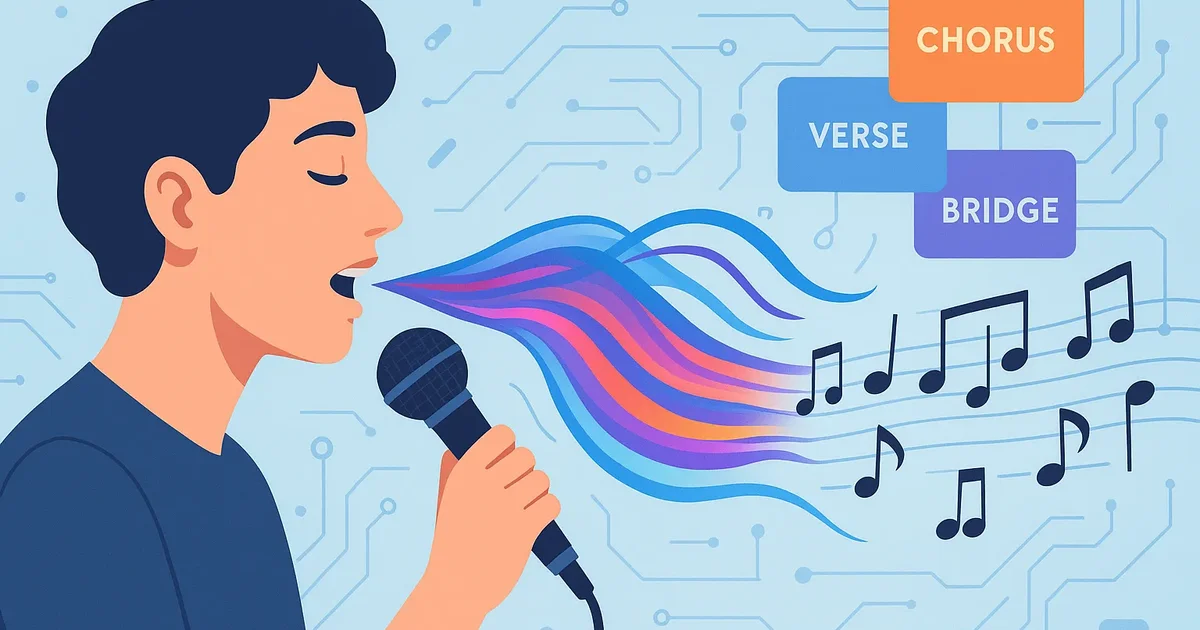
A structure. Songs have patterns — verse, chorus, verse, chorus, bridge, chorus is the most common one. You don’t need to understand why this structure works. You just need something to help you organize your expression into that shape.
That’s the list. Everything else is optional at the beginning.
The Four Elements of a Beginner’s First Song
1. A topic or feeling. Start with something real and specific. Not “love” (too broad) but “the feeling of texting someone and then watching the dots appear and then disappear” (specific, emotionally recognizable, singable). The more specific the feeling, the more people will recognize it.
2. A chorus. The chorus is the heart of the song — the part that says what the song is really about. It should be short (4-8 lines), simple enough to be understood on first listen, and emotionally direct. If someone heard your song once and could only remember one part, the chorus is the part.
3. A verse (or two). Verses build context for the chorus. They tell the story, develop the situation, or describe the circumstances that make the chorus’s emotion make sense. Verses can be longer and more specific than choruses.
4. A bridge (optional). A bridge is a short section that offers a new perspective before the final chorus — a shift in viewpoint or emotional realization. Many beginner songs don’t have one, and that’s fine. Add one if the song feels like it needs a turn.
Your First Song: A Step-by-Step Process
Step 1: Pick something true. Think of a specific feeling or experience you’d want to capture in a song. It doesn’t have to be dramatic. It just has to be something real that you’d recognize if you heard a song about it.
Step 2: Write three sentences about it in plain language. Not lyrics — just sentences. “The feeling I’m trying to capture is…” Then: “The specific moment or image that represents this is…” Then: “If someone heard this song, I’d want them to feel…”
These three sentences are your brief. They’re the foundation of your first lyrics.
Step 3: Use Lyric Genie to build the structure. Go to Lyric Genie’s chat and share your brief plus your three sentences. Tell it what genre you want, the emotional tone, and ask for a complete song with two verses, a chorus, and optionally a bridge.
Lyric Genie is a chat-based tool that transforms your song ideas into structured, professional lyrics ready for AI music generators like Suno. Just describe what you want to express — in text or by recording your voice — and it creates complete verses, choruses, and style prompts in seconds. No songwriting experience required.
Step 4: Read the output and react. Don’t expect perfection from the first draft. Look for lines that feel right and lines that feel wrong. The lines that feel wrong will tell you what you actually want to say. That reaction is the most valuable feedback you can get.
Step 5: Refine until it feels true. Continue chatting to change what doesn’t feel right. Be specific about what’s wrong: “The chorus feels too generic — can you make line 2 more specific?” Keep going until you can read the whole song without wanting to change anything.
The Music Theory Question
Music theory is the study of why certain combinations of notes, chords, and rhythms sound good together. It’s a genuinely useful skill for musicians. It is not required to write song lyrics.
Lyrics are language. They have their own rhythmic patterns (how many syllables per line, where the natural emphasis falls) and structural patterns (how verses differ from choruses). These can be learned by listening to songs you love and noticing what they do — no formal training needed.
The technical craft of fitting words to a specific melody, building chord progressions, and arranging music is a different skill set. You might want to develop that later. But writing lyrics that express something true, structured into a coherent song — that you can do right now.
From Lyrics to a Listenable Song
Once you have lyrics you’re happy with, you can hear them as an actual song in about 5 minutes. Lyric Genie also generates style prompts — descriptions of the musical sound — alongside your lyrics. Take these to an AI music generator like Suno:
- Open Suno and enable Custom Mode
- Paste your lyrics from Lyric Genie
- Paste the style prompts from Lyric Genie into the Style field
- Add the title and generate
Suno will create two versions of the song with vocals, instruments, and full production in under a minute. Listen, pick the one you like, and you have a real song.
For the full workflow, see the guide to using Lyric Genie with Suno.
What Comes Next
After your first song, the path forward is entirely open. You might discover an interest in deeper structure, metaphor, and lyrical craft — there’s a lifetime of learning available in those areas. You might want to learn guitar or piano to write music alongside your lyrics. You might want to explore production, or just keep making songs with AI music tools.
None of those are requirements. They’re options. The only requirement was always to start.