Is AI Replacing Songwriters? The Truth About Human-AI Collaboration
TL;DR: AI is not replacing songwriters. It’s doing what all creative tools do: it makes certain parts of the process faster and more accessible. The parts that make a song meaningful — the specific personal experience, the emotional decision-making, the thing only you know — still require a human. Here’s what that actually means in practice.
Few topics in music generate as much anxiety right now as AI. The concern is understandable: if a tool can generate song lyrics in seconds, what happens to the people whose craft that was? This is a real question worth taking seriously.
But “is AI replacing songwriters?” may be the wrong frame entirely. A more useful question is: what is AI actually good at, what isn’t it good at, and what does that mean for the future of songwriting?
What AI Is Actually Good At in Songwriting
AI language models are trained on enormous amounts of text, including song lyrics from every genre across many decades. This gives them genuine competence at several specific things:
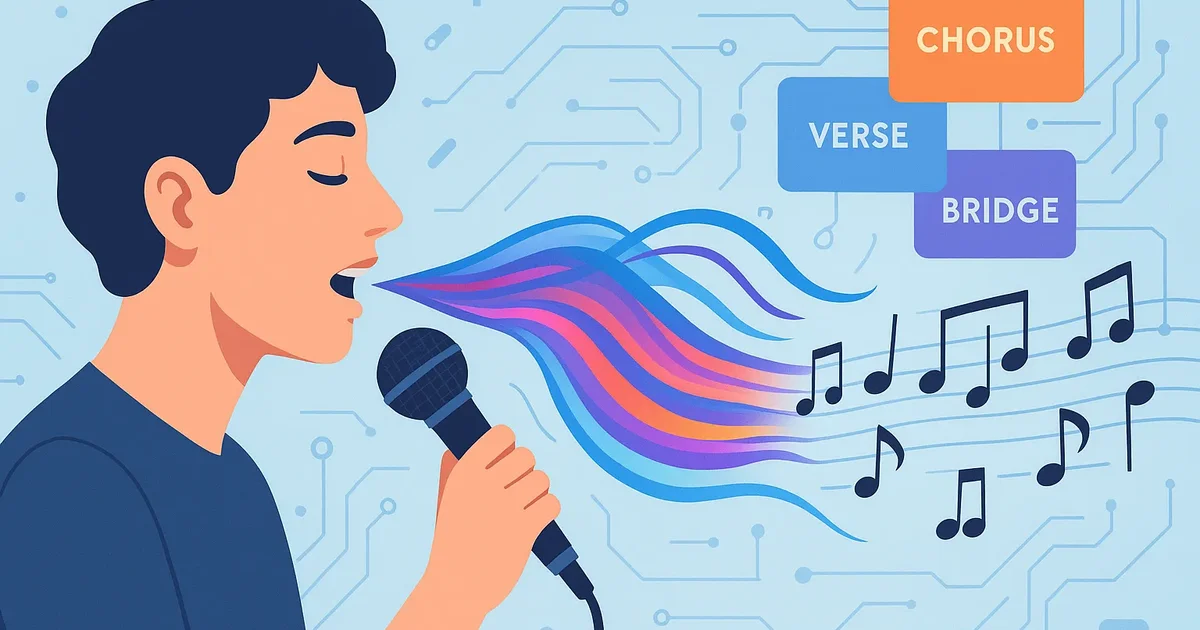
Structure. AI understands song structure deeply — verse-chorus patterns, bridge placement, pre-chorus function, outro conventions. It can generate structurally coherent songs reliably.
Rhyme and meter. AI can find rhymes that work, maintain consistent rhyme schemes across multiple verses, and keep syllable counts roughly consistent within sections.
Genre conventions. AI has absorbed the lyrical conventions of thousands of genre styles — what words and images appear in country songs vs. hip-hop vs. folk vs. pop — and can write convincingly within those conventions.
Speed and iteration. AI can generate 10 versions of a chorus in the time it takes a human to write one. For exploring different directions quickly, this is genuinely useful.
Getting past the blank page. This is where AI provides the most practical value to most people. The first draft is the hardest. Having something to react to — even something imperfect — is usually better than nothing.
What AI Is Not Good At
Your specific life. AI generates from patterns it learned, which means it generates things that sound like songs in general. Your specific memories, your particular relationships, the exact texture of a real moment in your life — that specificity is what makes great personal songs work, and AI doesn’t have access to it unless you tell it.
“She had this laugh that started low and built into something she couldn’t control” — that line came from someone who knew a real person. AI can produce lines that sound like that, but it can’t know that person.
Emotional truth over convention. AI optimizes for things that sound like songs. Sometimes the most powerful lyrical choice is deliberately unconventional — a line that breaks the rhythm, an image that doesn’t quite rhyme but feels more honest. Human songwriters make those choices consciously. AI defaults to what sounds most like the training data.
What only you know. The best songs say something that couldn’t have come from anyone else — a specific observation about experience, a way of seeing something that’s genuinely personal. That kind of originality doesn’t come from pattern matching.
The Real Division of Labor
The frame that actually matches what AI tools like Lyric Genie do in practice is this: AI handles the craft mechanics, the human provides the material.
Think about what “craft” means in songwriting: structure, rhyme, meter, genre conventions, word choices that scan well. These are learnable, teachable skills that follow patterns. They can be automated.
What can’t be automated is what you bring: the specific emotion you’re trying to express, the person you’re writing about, the moment you want to capture, the decision about what matters enough to be in the song.
Lyric Genie is a chat-based tool that transforms your song ideas into structured, professional lyrics ready for AI music generators like Suno. Think of it as a creative partner — you provide the emotional raw material and direction, it handles the structural assembly and craft refinement. Just describe what you want to express, and it creates complete verses, choruses, and style prompts in seconds.
Does Using AI Make the Song Less Yours?
This is the question people ask most, and it has a cleaner answer than the cultural anxiety suggests: no.
Consider what “yours” actually means when you use any other tool. A poet who uses a rhyming dictionary to find the right word still owns the poem. A novelist who uses grammar software still owns the novel. A filmmaker who uses editing software to cut a scene still owns the film.
Tools assist with execution. What makes creative work yours is the intention, the emotional specificity, the choices you made about what the work should be, and the judgment you applied to the output. AI is a more powerful tool than a rhyming dictionary, but the relationship is the same.
The songwriter who uses Lyric Genie to develop lyrics from their specific experiences, refines them until they feel true, and decides when they’re finished is the author of those lyrics. The tool helped with the craft. The person provided the art.
The Responsibility That Comes With It
Using AI responsibly in songwriting means staying honest with yourself about the process. The risk isn’t that AI will write your songs for you — it’s that you’ll let it. That you’ll accept the first generated draft without bringing your own specificity to it, and end up with a technically competent song that doesn’t actually say anything real.
The antidote is simple: treat AI output as a first draft that needs your emotional input. Every line that doesn’t feel specifically true should be replaced or refined. Continue the conversation until the lyrics say what you actually mean, not just what sounds like a song.
When you do that — when you provide the real material and use the tool to help shape it — the result can be genuinely yours and genuinely better than what you’d have produced alone.
What This Means for Non-Songwriters
The most significant change AI makes to songwriting isn’t for professional songwriters. It’s for the vast majority of people who have something real to say through music but lack the technical craft to express it.
The person who wants to write a song for their parent’s retirement but can’t figure out rhyme schemes. The person with a melody in their head and no words for it. The person who felt something profound and wants to express it in song form but has no training.
For these people — and there are far more of them than there are professional songwriters — AI doesn’t replace anything. It creates access to something that wasn’t available before.